Tracing The Arc You Lived
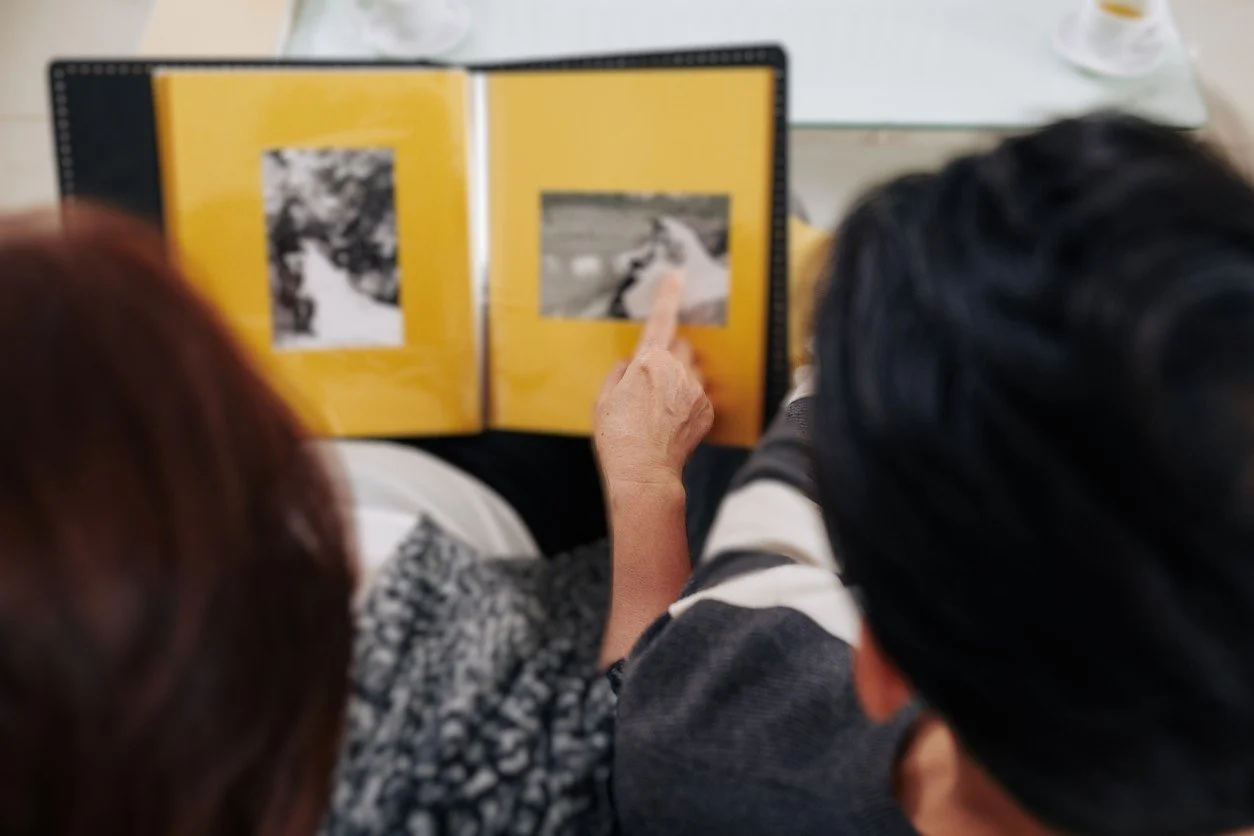
The last few years of my mother's life, we’d sit together with photo albums when I’d visit.
By her late 80’s, short-term memory came and went like the tide, but the early years stayed vivid. She'd point to photographs from high school and college and speak of them with a clarity she couldn't always find for last week.
She was sixteen when she graduated from high school, but poverty left her no hope for college. Because the men were all at war, the dean of Cheyney State Teachers College (historically Black) reached out with a scholarship and work in his office. It was a big step for her to leave home and live on campus (later repeated for grad school), but she became the first in her family to finish college. 80% of the next generation followed suit and all 13 of the following generation. She'd started something important without knowing she was starting it.
After making her way through this history, she’d reach the point of going to Howard University for grad school and say, “And then I met your father.”
Every time she said that, her hand would trace an arc in the air, beginning near her chest, sweeping upward and out to the right, off toward some horizon I couldn't see. The first time I noticed it I thought nothing of it. The second time I paid closer attention. The third time I understood.
That gesture was her life. Not meeting a man but the inflection point that changed everything. Her hand was showing me what her words couldn't fully carry: the whole trajectory, contained in a single movement her body still remembered when so much else had gone.
She could see the shape of it now, from the far end, though she couldn’t have traced that arc at thirty-five.
Two Lives, One Arc
My father's story had the same shape, drawn against a different set of limits.
Born in 1921 in the segregated South, the self-described runt of his family, he said he knew early that brains not brawn would be his path forward. He used his GI Bill to earn a doctorate in organic chemistry and spent the years that followed moving upward through historically Black universities – the only path available to a Black PhD at that time. When the Civil Rights Act of 1964 opened doors that had been closed his entire life, he walked through them. National Science Foundation, Director of Science Manpower Development globally. The executive ranks, US representative to the NATO science committee.
He moved us frequently: Tuskegee, Ames, Tuskegee again, Richmond, Norfolk, then Washington, DC. My mother followed, taught wherever they landed, built something in each place, and carried the distance from her close-knit Philadelphia family as the deep price she paid for a life that kept expanding.
What strikes me now is that their capabilities included vision as much as competence and drive to get ahead. My mother saw in a young man the arc his hand could one day trace for her. My father knew his path required moving toward something he could only imagine, in a world designed to limit his reach.
The Life You’ve Been Building
Neither of them experienced themselves as extraordinary. They were just doing what competence and drive required, finding the next opening, moving toward it. But the cost accumulated steadily alongside their achievements.
For people with high bandwidth who are building hard and far, the costs tend to be predictable. Relationships get less than they deserve. Investment in self gets deferred indefinitely, whether physical health, inner development, or simply time to rest and reflect. The parts of yourself that aren't needed by what you’re driving toward go untended.
My parents’ lives revealed this too. Decades without extended family nearby. The financial sacrifice to educate children on academic salaries. Relationships weaker than they might have been because their drive consumed nearly all they had to give. Sometimes these costs surface in ways hard to ignore. My father, who had been the engine of so much forward motion, lost enough of himself in retirement that a bottle became the substitute for purpose. My mother carried a depression that lifted only when dementia finally numbed it. These weren't character flaws but what happens when costs accrue long enough. They carried the costs because stopping wasn't something their competence and drive permitted.
The costs that capable people carry are often seen once they slow down.
And yet.
The arc of what capable people build is genuinely remarkable in the way a fully lived human life is: forward motion and cost, adventure and sorrow, wrong turns and surprising arrivals.
My mother started a college-going legacy in a family where none had gone before. My father moved from the segregated South to the NATO science committee in a single lifetime. They raised children who carried their vision forward in their own lives with their own arcs. They built something that outlasted them, because they lived on their own terms with enough drive and enough vision to keep moving forward.
That is what I see now, sitting with the photo albums, recalling my mother’s hand tracing that arc: the specific texture of two lives lived in a direction that was genuinely theirs, the benefits of their capabilities, as much as what they cost. And I feel the deep pride of being a witness, of having been shaped by people who refused to live smaller than their capability allowed.
This is what sufficient distance offers: clarity about the shape and beauty of a life that’s hard to see from inside it. To feel the full scope of what we’ve been making, and what it cost to build it, and to recognize that both are part of the same story.
And when you can finally see it, you find a life aimed at something real, marked by your unique drive, vision, courage. A life that no one else could have lived in quite the same way.
The arc of a life lived on your own terms, with all its costs and all its beauty, is the most original thing any of us will ever make.
Practice Invitation
Think of someone whose life arc you can see clearly because you have enough distance from it. A parent, a mentor, someone whose trajectory you've watched across years. What did they build that they couldn't fully see from inside it? What did the drive cost them that competence made easy to overlook?
Then turn it toward yourself. What is the arc of your own life, seen from as much distance as you can currently manage? What have you been building, at what cost, toward what?
The life that has been yours all along is more remarkable than you've probably let yourself believe. And what you've carried to build it isn't a footnote. It's the story.
And that’s The Gist of It™.
Thank you for reading.
If this resonated with you, I’d be honored if you’d forward it to someone who might appreciate it. Subscribe below to receive these weekly:

Marilyn Gist