Receiving Care: The Courage to Let Yourself Be Helped
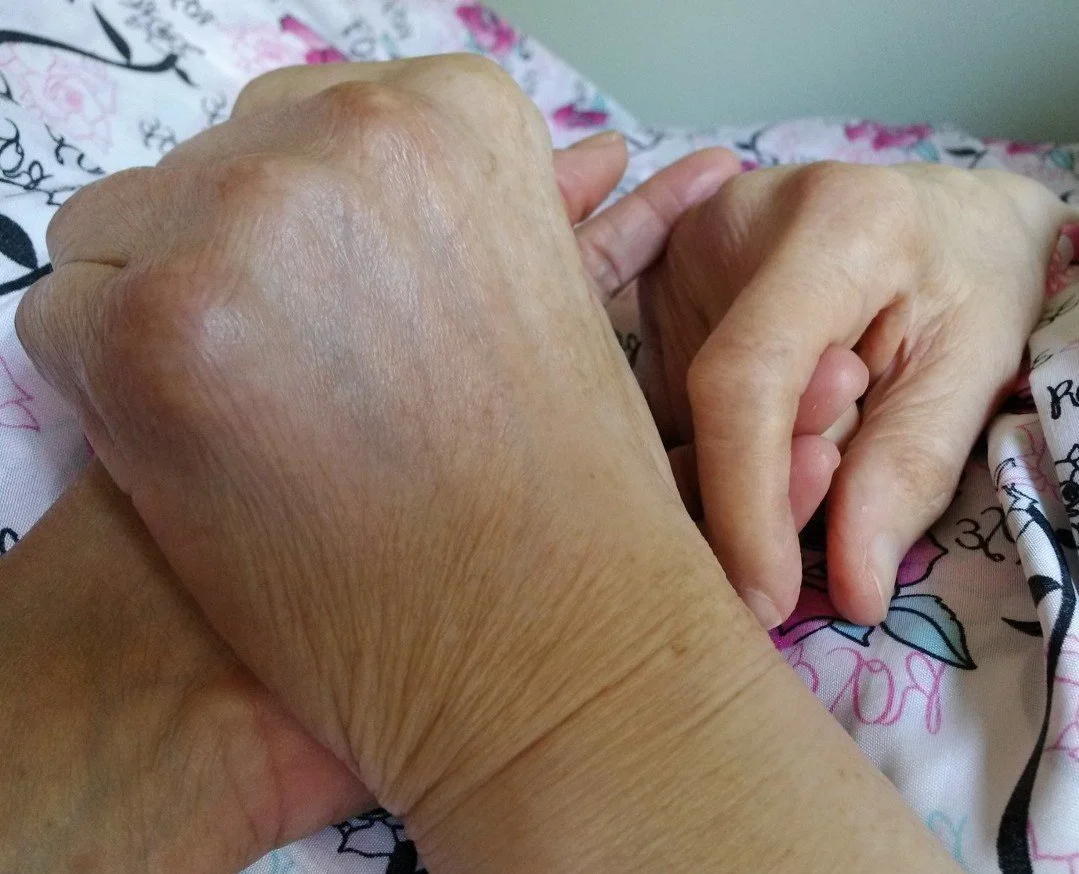
Mom’s hands in mine. A reminder that letting ourselves be held is its own form of courage.
Most high-achieving people carry a belief they rarely notice:
I am safest when I’m the one holding everything together.
It grows out of competence, yes, but also out of history. When we’ve learned to anticipate needs and stay steady while managing heavy responsibility, receiving help feels unfamiliar, even risky. Caring, in our view, moves outward. We become the ones who support others and stay composed even when it costs us. Without noticing, our competence hardens into a kind of armor.
I didn’t realize how strong that armor had become until life asked me to do what I least wanted to do: let someone help me.
The Armor We Don’t Recognize
At the time, I was an Associate Dean overseeing all graduate programs: students, faculty, curriculum, accreditation, executive education. The pace was relentless and the decisions unceasing. Around that same period, my mother, who had moved to Seattle two years earlier, declined rapidly and entered hospice. I was her only family nearby. Every emotional, logistical, and practical responsibility fell to me.
I told myself I was fine. I believed I could carry both my work and her care.
What I didn’t fully register was how strained I was holding everything together and how little room there was for anything unplanned. My steadiness was determined but probably more fragile than I acknowledged.
My second-in-command, Cindy, noticed what I was trying to outrun.
She approached me one afternoon and said, firmly and without apology, “Why don’t you take family leave? We can handle things. You need to be with your mom.”
I responded instantly. “No, really, I’m fine.”
The resistance rose before I could even think. I didn’t want to burden others or step back at a moment when so much depended on me. I didn’t want to appear less capable. Beneath all of that sat a truth I hadn’t seen:
I no longer knew how to let someone care for me.
Eventually, I said yes. And when I stepped back, something unexpected happened.
Letting myself be helped didn’t make me less capable. It made me less alone.
The Courage to Let Ourselves Be Held
What surprised me most was not the relief of leaving work, but the relief of being seen. For the first time in a long while, I wasn’t the one managing everything or proving I could handle it. I was allowed to rest inside someone else’s steadiness.
In that opening, a deeper understanding surfaced.
Sometimes strength isn’t the courage to keep going.
It’s the courage to let yourself be held.
I had built an identity around being the reliable one, the person who didn’t need much and could be counted on in difficult moments. Many people who care deeply and carry a great deal of responsibility recognize this pattern. We often learn early that the safest place to stand is just ahead of our own needs.
These strengths serve us. They make us capable and trustworthy. But they also create a blind spot:
Competence can become armor. And armor keeps caring at a distance.
Over time, we begin to believe that receiving support asks too much of others or risks our credibility. Some part of us worries about what might surface if we stop long enough to accept help. So we keep going, relying on the muscle memory of composure.
But refusing help doesn’t make us strong.
It makes us isolated.
Receiving care is about participation, not dependency.
It brings us back into mutuality, the place where relationships are formed rather than merely maintained. It widens our understanding of strength as not just endurance but capacity. And it communicates something essential to the people around us: I trust you enough to let you in.
High-functioning people often struggle here, especially leaders. If I stop, things will unravel. If I step back, I’ll lose ground. Yet the paradox is simple: people tend to trust us more when we are honest about our limits, not less.
Closeness doesn’t grow where one person carries everything, whether in families, friendships, or teams. Connection deepens when responsibility is shared and care is allowed to move in both directions.
That month away, claimed with Cindy’s help, gave me the chance to be fully present with my mother in her final days. It allowed me to honor her life without being ground down by obligation. And it taught me something I had somehow missed, despite years of teaching and writing about relational life:
Caring is not earned. It’s exchanged.
We don’t have to prove ourselves worthy of rest or justify needing support. And we don’t have to carry everything simply because we know how.
The people who care for us want our presence, not our perfection. And presence requires capacity. To operate at full capacity, we sometimes need to let others come close.
Practice Invitation:
Here is the invitation I’m practicing myself.
The next time someone reaches toward you with support, pause.
Let the moment land.
Notice what rises before you respond.
And if you can, consider saying yes before your instinct says no.
Let yourself be helped, not because you are failing or weak, but because you don’t have to carry everything alone.
When care is allowed to flow both ways, something in us softens. Something in the relationship strengthens. And something in our shared life becomes more possible.
And that’s The Gist of It™.
Thank you for reading.
If this resonated with you, I’d be honored if you’d forward it to someone who might appreciate it. They can subscribe below:

Marilyn Gist